Case Study: Why Became India's Most Successful Brand
 Atul Thakur26 Jun 20264 min read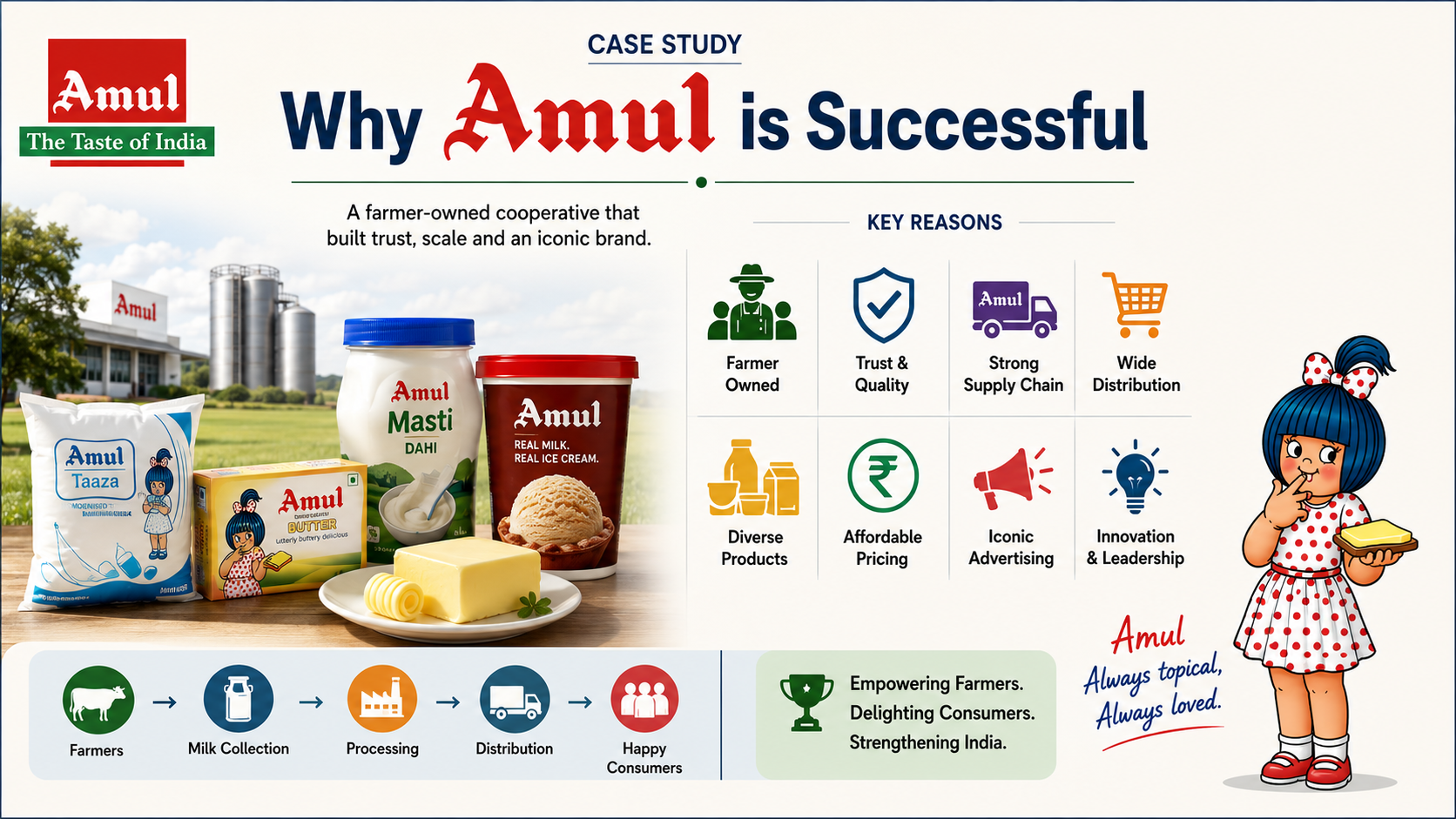
Case Study: Why Became India's Most Successful Brand
Introduction
Very few brands in India enjoy the trust, emotional connection, distribution reach, and market leadership that Amul does.
Amul is not merely a dairy company.
It is one of the world's largest farmer-owned cooperative movements and a management case study taught in leading business schools because it solved three problems simultaneously:
Farmers' prosperity
Consumer trust
National self-reliance
Today, Amul collects milk from millions of farmers every day, processes it through a vast network, and sells hundreds of dairy products across India and abroad.
The question is:
Why has Amul remained successful for more than 75 years while hundreds of dairy brands have disappeared?
Background
Founded: 1946
Headquarters:
Parent organization:
Founder of the movement:
Architect of modern dairy revolution:
The objective was simple:
Eliminate middlemen and ensure farmers receive a fair price while consumers receive quality products.
1. A Purpose Bigger Than Profit
Most companies exist to maximize shareholder wealth.
Amul exists to maximize farmer prosperity.
Every strategic decision answers one question:
Will this improve farmers' income?
When purpose is clear:
Employees become committed.
Customers feel connected.
Governments support the organization.
Society respects the brand.
Business Lesson
People buy products.
Society supports purpose.
2. Cooperative Business Model
Unlike private dairy companies:
Milk Producer → Village Society → District Union → State Federation → Consumer
Every farmer is effectively an owner.
Therefore,
Better milk
Honest pricing
High loyalty
Continuous supply
The interests of suppliers and the company are aligned rather than opposed.
3. Massive Procurement Network
Every morning and evening millions of litres of milk are collected.
This creates:
Fresh supply
Predictable production
Economies of scale
Stable pricing
Scale reduces costs.
4. Brand Trust
Consumers never buy milk.
They buy confidence.
Amul consistently delivers:
Hygiene
Quality
Availability
Affordable pricing
When uncertainty exists,
people automatically choose the trusted brand.
5. Lowest Cost Supply Chain
Amul invested heavily in:
Chilling plants
Milk collection centers
Cold chain logistics
Processing plants
Transportation
Competitors cannot easily replicate this network.
This creates a significant competitive moat.
6. Product Diversification
Amul started with milk.
Today it sells:
Butter
Cheese
Ice cream
Paneer
Ghee
Chocolate
Curd
Lassi
Protein products
Milk powder
Beverages
If demand falls in one category,
others continue generating revenue.
This reduces business risk.
7. Affordable Pricing Strategy
Amul rarely positions itself as premium.
Instead it focuses on:
High volume + reasonable margin = sustainable profit
This aligns with Indian consumer behavior.
8. Extraordinary Distribution
Amul products are available almost everywhere:
Urban supermarkets
Rural shops
Railway stations
Airports
Hotels
Restaurants
Tea stalls
Availability creates habit.
Habit creates loyalty.
9. Consistent Quality
Consumers know exactly what to expect.
Consistency creates trust.
Trust creates repeat purchases.
Repeat purchases create brand equity.
10. The Iconic Advertising Campaign
Perhaps no Indian campaign has lasted as long as the famous Amul Girl.
The witty topical advertisements:
Comment on current affairs
Create emotional recall
Build brand personality
Keep advertising fresh without changing identity
Very few brands maintain such consistency over decades.
11. Innovation Without Losing Identity
Amul continuously introduces new products while keeping its core promise:
Quality dairy at affordable prices.
Innovation supports the brand instead of confusing customers.
12. Strong Leadership
built systems rather than dependence on individuals.
Leadership succession ensured the institution outlived its founders.
This is one of the greatest lessons for entrepreneurs.
13. Strong Rural Ecosystem
Amul invests in:
Veterinary care
Animal health
Feed quality
Farmer education
Technology adoption
When farmers become stronger,
Amul becomes stronger.
14. Operation Flood
India once depended on imported milk.
The nationwide dairy development initiative known as transformed India into one of the world's largest milk producers by expanding the cooperative model and strengthening dairy infrastructure.
15. Emotional Branding
Consumers believe:
Amul supports farmers.
Amul represents India.
Amul is trustworthy.
Amul is part of everyday family life.
Strong brands sell emotions before products.
SWOT Analysis
Strengths | Weaknesses |
|---|---|
Trusted brand | Complex cooperative governance |
Huge distribution | Slower decision-making than startups |
Farmer loyalty | Thin margins in some categories |
Affordable pricing | Dependence on milk supply |
Opportunities | Threats |
|---|---|
International expansion | Global dairy brands |
Health & protein products | Changing consumer preferences |
Digital commerce | Rising input costs |
Premium dairy | Climate impact on milk production |
Key Business Lessons for Entrepreneurs
Build purpose before profit.
Create systems that survive the founder.
Make suppliers partners.
Earn trust through consistency.
Invest in distribution, not only marketing.
Scale through systems rather than effort.
Diversify only after mastering the core business.
Build emotional equity, not just market share.
Innovate while preserving your brand promise.
Focus on long-term reputation over short-term gains.
Relevance to Business Excellence Participants
Amul demonstrates that a business becomes world-class not by having the best product alone, but by building an integrated business system where every element—purpose, procurement, operations, branding, distribution, leadership, and customer trust—works together.
For entrepreneurs, the central lesson is:
People may copy your product. They may copy your price. They may even copy your marketing. But they cannot easily copy a well-designed business system.
That is the enduring competitive advantage behind Amul's remarkable success.
Be the first to react
Comments
Loading comments…
Newsletter
Get new posts in your inbox
No spam. Unsubscribe anytime.