The Mahindra Scorpio Story Every Entrepreneur Must Know There are products
 Atul Thakur10 Sept 20264 min read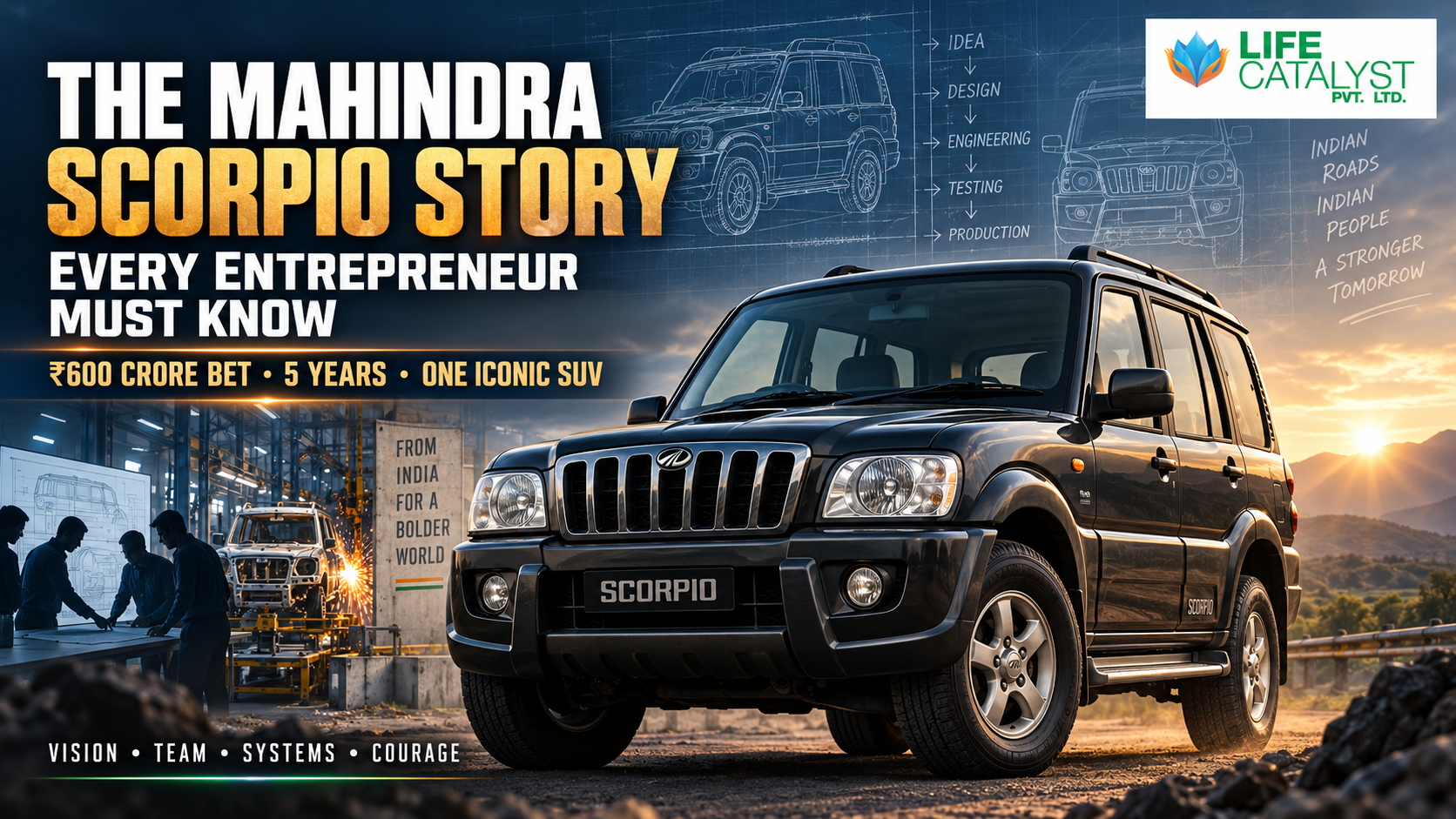
The Mahindra Scorpio Story Every Entrepreneur Must Know
There are products that generate revenue—and there are products that redefine the company that creates them.
The Mahindra Scorpio belongs to the second category.
The Challenge
During the mid-1990s, Mahindra & Mahindra was best known for tractors and rugged utility vehicles based largely on older Jeep platforms. As global automobile companies entered India, Mahindra faced a defining question:
Should it remain an assembler of utility vehicles, or develop the capability to create a world-class automobile of its own?
Consultants reportedly advised Mahindra to concentrate on tractors because an Indian company might struggle to compete with global automobile manufacturers.
Anand Mahindra chose ambition over comfort.
He persuaded the board to approve approximately ₹600 crore—the company’s largest investment at that time—to develop an entirely new SUV. A board member later told him that his position could have been at risk had the project failed. "Businessworld’s account of the decision" (https://web.archive.org/web/20110116215357/http://www.businessworld.in/bw/2011_01_15_The_Surface_To_Air_Company.html)
This was not reckless gambling. It was a calculated commitment to building a new organisational capability.
The Team Behind the Dream
Mahindra brought in Dr. Pawan Goenka, who had worked with General Motors in the United States, to lead the ambitious project.
The company did not possess every technology, facility or specialist needed to develop a modern vehicle. Instead of allowing these limitations to stop the project, Mahindra created a new operating model.
It established a small, empowered, cross-functional team and built strong partnerships with suppliers. Mahindra defined the vehicle’s design, performance expectations, quality standards and target cost, while suppliers participated deeply in designing, engineering, testing and validating major systems.
The suppliers were not treated merely as vendors.
They became development partners.
This collaborative approach allowed Mahindra to mobilise expertise beyond its own organisation. The project reportedly took about five years and involved approximately ₹550–600 crore, including manufacturing-facility improvements. The Scorpio finally reached the Indian market in June 2002. "Development history" (https://en.wikipedia.org/wiki/Mahindra_Scorpio)
Mahindra Did Not Copy the Market
Mahindra understood the Indian customer.
Indian buyers wanted:
- The strength and road presence of an SUV
- The comfort of a passenger car
- The ability to handle difficult Indian roads
- Space for the family
- A prestigious appearance
- Ownership at an achievable price
The Scorpio was therefore not developed as a cheaper imitation of a foreign vehicle. It was designed around the needs and aspirations of Indian consumers.
That distinction was crucial.
Great entrepreneurs do not merely follow the market. They identify an unfulfilled aspiration and build a category around it.
The Launch That Changed Mahindra
When the Scorpio was launched in 2002, it gave Mahindra something greater than sales.
It gave the organisation confidence.
The project demonstrated that an Indian company could conceive, engineer, manufacture and market a modern vehicle with global ambitions. It helped transform Mahindra’s identity—from a manufacturer of traditional utility vehicles into a serious, innovation-driven SUV company.
The Scorpio subsequently became one of India’s most recognisable automotive brands. Its continuing evolution—including the Scorpio Classic and Scorpio-N—shows the power of creating intellectual property and brand equity that can remain valuable for decades.
Mahindra’s own account describes how Dr. Pawan Goenka and his small team overcame numerous challenges to create the Scorpio within five years. "Mahindra Group’s official Scorpio story" (https://www.youtube.com/watch?v=fDRwopCCHNw)
Seven Lessons for Every Entrepreneur
1. Your greatest risk may be remaining comfortable
Mahindra could have continued improving existing vehicles. Instead, it invested in creating an entirely new future.
A business that protects only its present will eventually lose its future.
2. Think bigger than your current capabilities
Mahindra did not initially possess every capability required to create the Scorpio. It committed to the vision and then assembled the talent, technology and partnerships needed to deliver it.
Your present capability should not determine the size of your future vision.
3. Build a team—not personal dependency
The Scorpio was not created by one heroic individual. It was delivered through leadership, a capable team, clear accountability and coordinated execution.
Entrepreneurs must move from:
“I do everything” to “the organisation delivers results.”
4. Convert vendors into strategic partners
Mahindra used supplier expertise as an extension of its own organisation.
SME owners must stop selecting suppliers only on the lowest price. The right partners can contribute technology, speed, innovation, quality and scale.
5. Start with the customer, not the factory
The Scorpio succeeded because it answered a real customer aspiration.
Never begin by asking:
“What can we manufacture?”
Begin by asking:
“What important problem or aspiration can we solve better than anyone else?”
6. Control cost without reducing ambition
Frugal innovation is not about producing something cheap. It is about achieving a powerful outcome through intelligent design, collaboration and disciplined resource allocation.
7. One courageous project can transform a company
The Scorpio did more than add another product to Mahindra’s portfolio. It changed the company’s confidence, capabilities, positioning and future possibilities.
Every entrepreneur must identify their own “Scorpio Project”—the project that can take the organisation from its current identity to its next level.
The Final Question
What is the one product, system, market or innovation that could completely transform your company?
Are you postponing it because:
- You do not have enough money?
- You do not have the right people?
- You do not possess all the required knowledge?
- Failure appears too dangerous?
Remember the Scorpio story.
You do not need to possess every resource before beginning. You need a compelling vision, the courage to commit, the discipline to build a team and the ability to create an execution system.
Entrepreneurs do not merely predict the future.
They take responsibility for creating it.
— Atul Thakur
Founder & Chairman
Life Catalyst Private Limited
Our commitment: Every SME becomes successful.
Be the first to react
Comments
Loading comments…
Newsletter
Get new posts in your inbox
No spam. Unsubscribe anytime.